Sources and limits
The decision
- On 1 August 2024, Hershey told investors it would raise prices, but "we are not going to price the entire portfolio." It expected "about 6 to 7 points of net price realization." CEO Michele Buck, Q2 2024 earnings call, Hershey's own transcript.
- "We've taken pricing on about half of our chocolate pounds." CFO Steve Voskuil, Q3 2024 earnings call, 7 November 2024 (transcript by Equibles).
- Hershey buys cocoa 3 to 24 months ahead, so a price spike reaches its costs gradually. "Commodity price increases ultimately result in corresponding increases in our raw material and energy costs." Q2 2024 quarterly report; 2024 annual report.
- Mars planned to raise chocolate prices 10–11% across its whole line from December 2024. RBC Capital Markets store checks, reported by Investing.com, 2 October 2024. Mars is private and does not publish its prices, so this is the best public figure for what it took.
The goal
In February 2025 Hershey guided to 2025 net sales up at least 2%, and an adjusted gross margin down about 650–700 basis points from 2024's 43.3%. Hershey didn't state a gross-profit figure; the goal on the page is the one that guidance implies at the weaker end: $11.20bn × 1.02 × 36.3% = $4.15bn. Hershey said volume would be "slightly down"; the page reads that as −0.5%.
- Net sales "at least 2%", and 2024's margin and sales: Hershey Q4 2024 results, 6 February 2025 (the margins are in the "Non-GAAP gross margin" row).
- Margin down 650 to 700 basis points: Hershey's Q1 2025 remarks, 1 May 2025, repeating the February outlook.
- Volume "slightly down": MarketBeat's summary of the 6 February 2025 call.
Gross profit is the part of earnings pricing touches. Earnings also depend on overhead, marketing, tariffs, interest and tax, which the model leaves alone.
The numbers
| Input | Value | Source |
|---|---|---|
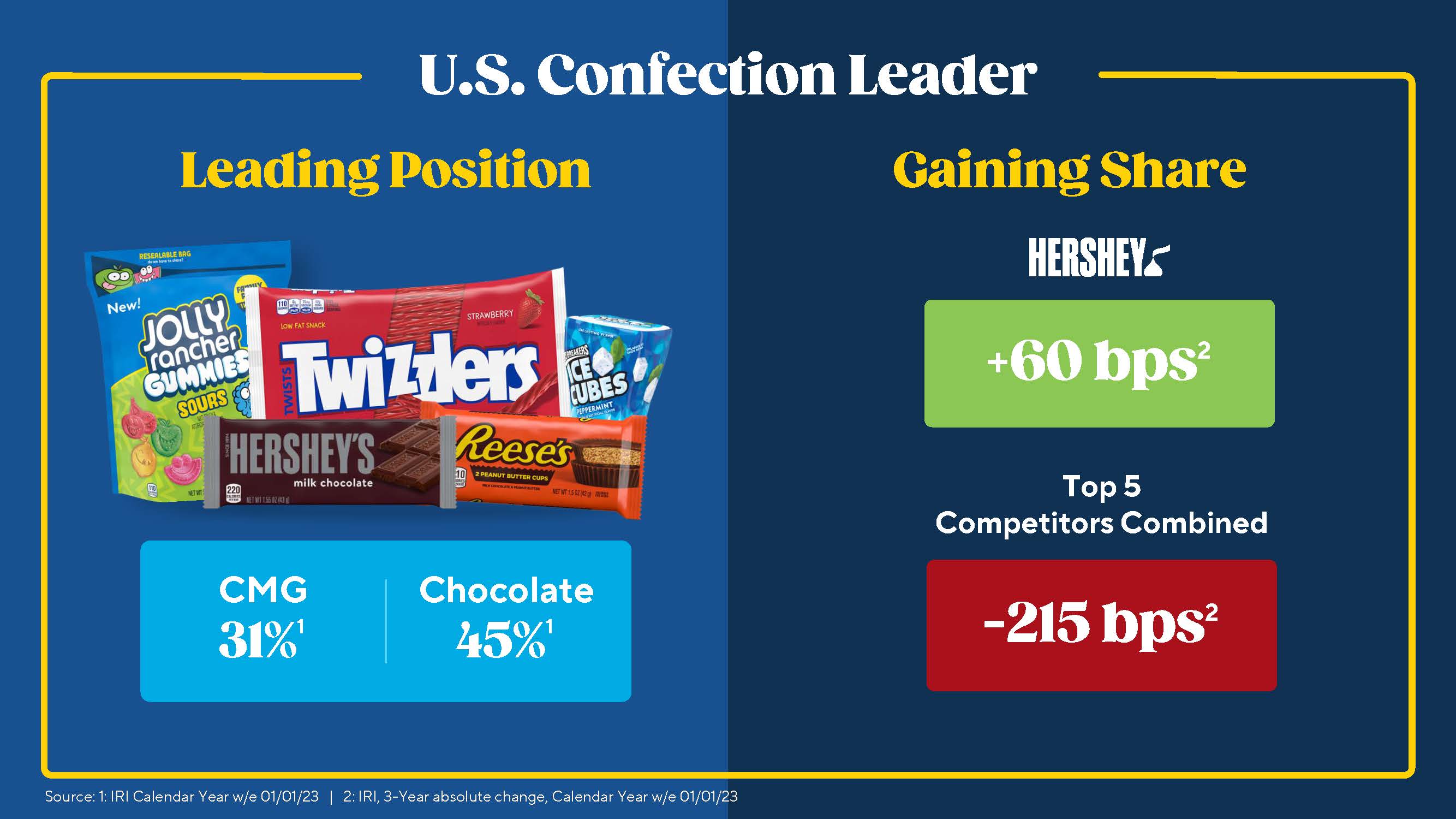
| Hershey's share of US chocolate | 45% | Hershey Investor Day, March 2023, slide "U.S. Confection Leader" (IRI, calendar 2022) |
| 2024 adjusted gross margin | 43.3% | Hershey Q4 2024 results |
| 2024 net sales | $11.20bn | Hershey Q4 2024 results |
| 2025 cost per unit | 66.6% of the 2024 price | Worked out from 2025's 37.2% margin at about +6% price, Hershey Q4 2025 results. It is the cost Hershey's hedges delivered; much of it was bought before the decision |
| How much less chocolate people buy when all of it costs more | 0.5% less per 1% rise, best estimate (range 0.3–0.8%) | Circana, 2023 US chocolate: dollars +5.8%, units −5.4%. Reported by FoodNavigator, April 2024. That is +11.8% per unit, and 0.5% fewer units per 1% |
| How easily people switch between Hershey and Mars | About 0.7% of Hershey's volume per 1% of price gap, best estimate, low confidence (range 0.3–1.7%) | Set between fits to Hershey's 2023 and early-2024 volume; the arithmetic is in the code. No published study measures it |
The two shopper numbers and Hershey's share come from sources published before the decision on 1 August 2024. The 2024 and 2025 figures and the goal come from Hershey's later reports. Mars's move is what the page asks you to set.
The model against what happened
| Model, Hershey +6.5%, Mars +10.5% | Actual 2025 | |
|---|---|---|
| Gross profit | $4.40bn | $4.35bn |
| Gross margin | 37.5% | 37.2% |
| Volume | −1.6% | −1% for the whole company, −2% in North America Confectionery (volume/mix, to the nearest point) |
Actual gross profit and margin are Hershey's reported non-GAAP figures, the basis its guidance used (Hershey Q4 2025 results). The model's 2025 cost is worked out from that margin, so the margins agree by construction; volume is the independent check.
What it leaves out
- One year only. Share lost in 2025 costs nothing later in the model.
- The model works from changes in price, not price levels. Nobody publishes Hershey's and Mars's shelf prices, and whatever gap existed in 2024 is already reflected in the 45/55 split of the shelf. So it can say what happens when Hershey raises prices more or less than Mars, not whether Hershey costs more.
- Two sides of the shelf: Hershey, with 45% of US chocolate, and everyone else, with 55%. Mars is the largest of the rest. The Mars move you set is applied to that whole 55%, which assumes the rest of the shelf moved with Mars.
- Hershey's move is an average across its range. The real increase covered about half its chocolate.
- Cost per unit is fixed, so lower volume doesn't raise it.
- No retailers: the price Hershey sets is the price shoppers pay.
- Shoppers get only a little more price-sensitive as prices climb. Hershey's own elasticity moves from −0.91 at 2024 prices to about −1.03 at +50%, because the model has no price points where people suddenly walk away. Well beyond the moves Hershey and Mars made, it overstates what a price increase would earn, so the inputs stop at +20%.
- The two shopper numbers are estimates. The model shows how the answer moves with them.
The code
The model is about sixty lines of Python, public at github.com/owencosans/Brandenburg. This page runs the same math in your browser, and a test checks the two agree. Nothing you enter leaves the page.